
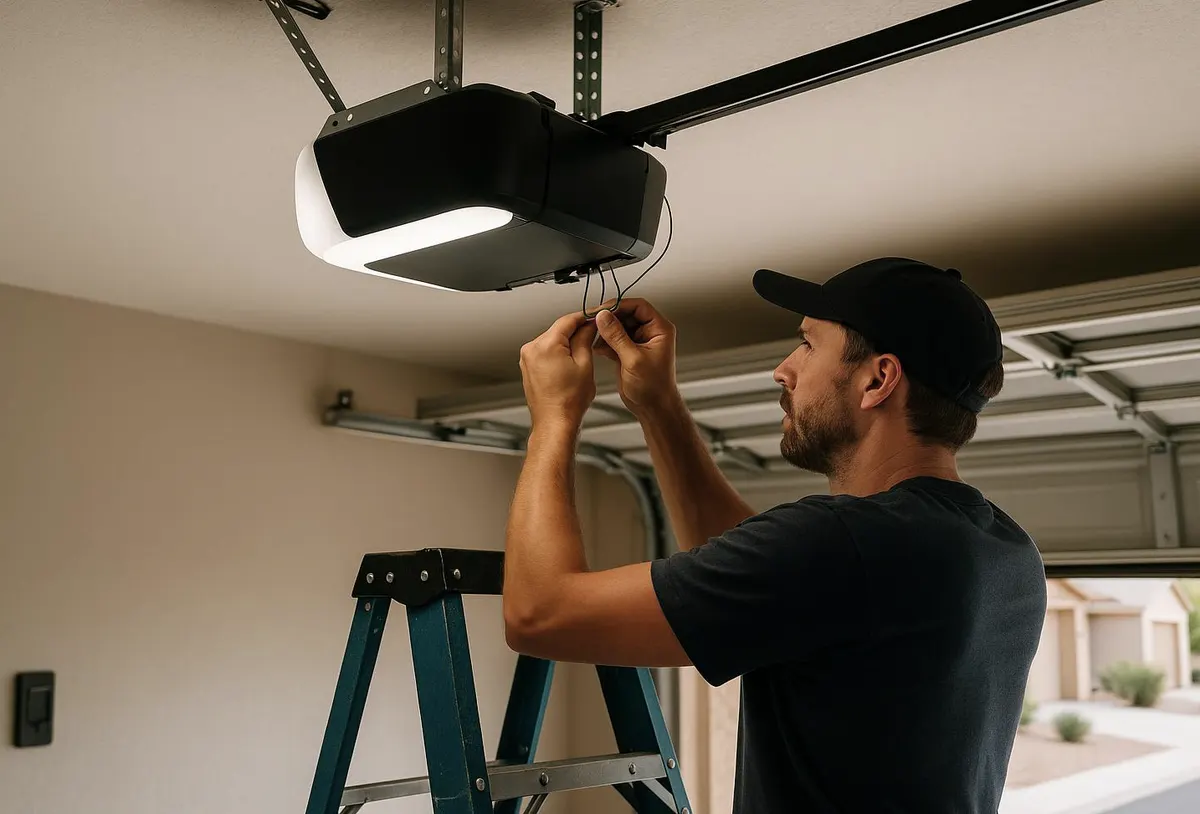
A good garage door quote tells you exactly what's broken, exactly what parts are going in, and exactly what you're paying for labor versus parts. If a quote can't answer those three things in writing, that's your answer before you even get to price.
What a Legitimate Quote Actually Includes
Garage door pricing isn't mysterious, but it is easy to obscure. A clear, honest quote should break down into distinct pieces rather than one lump number:
- Diagnosis — a plain description of what's actually wrong (a broken torsion spring, a worn roller, a misaligned sensor), not just "garage door not working."
- Parts — the specific part being replaced, ideally with the brand or spec noted. Springs, cables, and openers vary enough in quality that "a spring" isn't a real line item.
- Labor — a separate charge for the technician's time, so you can see what you're paying for the work itself versus the hardware.
- Warranty terms — how long parts and labor are covered, and whether that's in writing, not just spoken.
National ranges for common repairs are a useful gut-check: a torsion spring replacement typically runs somewhere in the $150–$350 range depending on spring size and door weight, while opener repairs often land between $100–$300. A full installation is a bigger range, often $700–$2,500+, depending on the door type and whether the opener is included. If a quote is wildly outside these ranges in either direction, ask why.
What to Look For
- Itemization. Every part and every hour should be visible. If the whole repair is one number with no breakdown, push for detail.
- Matched parts. Springs, cables, and openers are usually sold in sets or pairs for a reason — one new spring paired with one old one is a mismatch waiting to fail again within months.
- A written warranty. Verbal promises don't help you six months later when a spring snaps again.
- A real company name and license info on the paperwork, not just a phone number scrawled on a business card.
What to Ignore
Some things on a quote (or pitched alongside it) are noise:
- Brand-name upsells you didn't ask about. A technician recommending a specific opener brand because it's genuinely a better fit is fine. A hard push toward the most expensive option with vague reasoning is a sales tactic, not a diagnosis.
- Scare-tactic language. Phrases like "this could fail any day and hurt someone" without a clear technical reason are designed to rush your decision, not inform it.
- "Full system replacement" recommendations for a single failed part. Sometimes a full replacement genuinely makes sense — an old door with multiple aging components, for instance — but it should come with a clear explanation, not just a bigger number.
Questions to Ask Before You Say Yes
- What exactly is failing, and how did you confirm it? A spring with visible gaps between coils, a cable frayed at the drum, a sensor that's been knocked out of alignment — a real diagnosis points to something specific.
- Are the parts new, and from what manufacturer? Reused or off-brand hardware isn't always bad, but you should know which it is before agreeing.
- Is this a matched-pair replacement if applicable? Especially true for torsion springs on double doors — replacing one and leaving the other at a different age is a common shortcut that costs you again later.
- What's covered under warranty, and for how long? Get it in writing, including whether labor is covered separately from parts.
- What happens if this doesn't fix the problem? A straight answer here (a revisit at no extra labor charge, versus a vague "we'll see") tells you a lot about how the company operates.
- Is there a trip or diagnostic fee, and does it apply toward the repair if I go ahead? Reasonable either way, but you want to know before the work starts, not after.
Local Factors Worth Mentioning on the Quote
A few things specific to this area are worth bringing up with whoever's quoting the job. Homes with older doors sometimes need seismic retrofit hardware — reinforced struts or bracing — addressed at the same time as a repair, and that should show up as its own line item if it applies. Dust and wildfire smoke during dry months can work into opener sensors and tracks, so if a technician is recommending a sensor replacement, ask whether a cleaning and realignment might solve it first. And if you're scheduling installation or spring work heading into the wetter winter months, ask whether the quote accounts for weatherstripping or seal replacement at the same time — it's a small add that's easier to do while the door's already apart.
When to Call Vacaville Garage Door Pro
If you've got a quote in hand and it doesn't hold up to these questions — vague parts, no warranty in writing, pressure to decide on the spot — it's worth getting a second look. Vacaville Garage Door Pro provides straightforward estimates for garage door repair and spring replacement, with the diagnosis explained before any work starts and parts specified up front. If your current quote involves a full opener swap or new installation, we can also walk you through garage door installation and opener options without the upsell.
If you're in Vacaville or anywhere else in Solano County and want a second opinion on a repair quote, or just want the job done right the first time, give Vacaville Garage Door Pro a call.